
Residential Lighting Series — Part 4: Colour Temperature, Brightness & Controls — Creating the Right Feeling at Home

A lighting fixture can look beautiful and still produce the wrong light for the room.
This is one of the most important distinctions in residential lighting design.
Once you've determined each fixture's location and purpose, the next step is understanding the quality of the light itself—its colour temperature, brightness, colour rendering, direction, and level of control.
These characteristics can completely change how a space feels.
A warm living room can become uncomfortable if the light is too cool. A beautifully finished kitchen can feel dull if colours are poorly rendered. A bedroom can feel overly bright if every fixture operates at full intensity. And even a well-planned lighting layout can become frustrating if homeowners cannot easily control different zones.
Good residential lighting therefore goes beyond choosing fixtures.
It is about creating the right light for the right space, at the right time.
Colour Temperature — Understanding Warm and Cool Light
Colour temperature describes the appearance of white light and is measured in Kelvin, commonly shown as K.
Lower colour temperatures produce warmer light, while higher colour temperatures appear cooler.
In residential environments, common choices often include:
2700K — warm and comfortable
3000K — warm but slightly cleaner and more contemporary
3500K — more neutral
4000K and above — noticeably cooler and often more associated with work-oriented or commercial environments
No single colour temperature is perfect for every home.
The correct choice depends on the architecture, finishes, furniture, natural light, and function of the space.
A bedroom designed for relaxation may benefit from a warmer appearance, while a highly functional workspace may require a slightly more neutral quality of light.
The goal isn't simply to choose a number.
It is to understand the atmosphere that number creates.
Warm Light Can Change How Materials Feel
Lighting strongly influences the way we perceive finishes.
Wood, natural stone, warm fabrics, brick, and earth-toned materials often respond beautifully to warmer light.
Cooler light can sometimes make these same materials appear flatter or less inviting.
On the other hand, very warm lighting may not always suit spaces dominated by crisp whites, cool greys, or highly contemporary finishes.
This is why lighting decisions should ideally be made with real material samples in mind.
A cabinet door viewed under showroom lighting may look different after installation in the home.
The same is true for flooring, wall paint, stone, and furniture.
Designers often spend significant time selecting finishes, but the final appearance of those materials is partly determined by the lighting that reveals them.
Brightness Is About More Than Wattage
For years, homeowners chose lamps mainly by wattage.
But wattage measures energy consumption, not how much visible light a bulb produces.
A more useful measure is lumens.
Lumens describe how much light a source produces.
The appropriate brightness depends on several factors:
Room size
Ceiling height
Surface colours
Amount of natural light
Fixture type
Task requirements
Age and visual needs of the occupants
Number of lighting layers in the room
A dark room with deep finishes may absorb more light than a room with bright reflective surfaces.
Likewise, a kitchen countertop requires a different level of illumination than a television wall.
This is another reason why simply repeating the same fixture throughout the entire house may not create the best result.
More Brightness Does Not Automatically Mean Better Lighting
A common mistake in residential projects is designing for maximum brightness.
The assumption is understandable: if the room can be made very bright, the homeowner can always turn lights off.
But this can result in ceilings filled with fixtures, excessive glare, unnecessary energy use, and spaces that feel more commercial than residential.
The better approach is to design the right amount of light and then provide flexibility.
This is where dimming becomes particularly valuable.
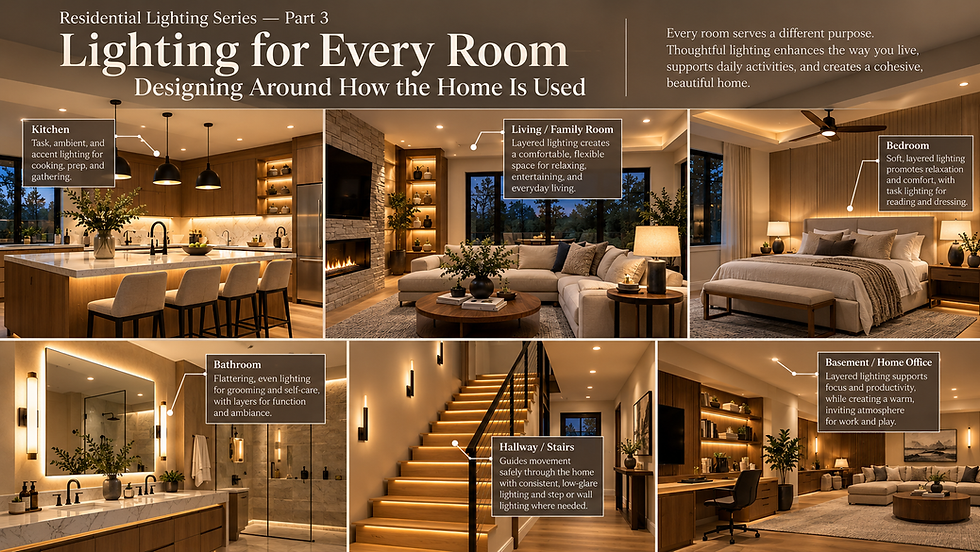
A kitchen can be brighter during food preparation and softer during dinner.
A living room can be well illuminated when cleaning or entertaining and much warmer in the evening.
A bathroom can provide strong functional lighting in the morning and softer lighting late at night.
Lighting should adapt to life rather than forcing people to adapt to one fixed condition.
Colour Rendering — Seeing Materials the Way They Were Intended
Colour temperature tells us whether light appears warm or cool.
Colour rendering tells us how accurately colours appear under that light.
This is commonly described using CRI, or Colour Rendering Index.
A higher-quality light source can make skin tones, fabrics, artwork, food, wood, and finishes appear more natural.
This matters particularly in residential environments where materials have been carefully selected.
Consider a kitchen with natural wood cabinetry, stone countertops, colourful food, and decorative finishes.
If the lighting does not render colours well, the entire room can feel less refined—even when every material is premium.
The same principle applies in bathrooms, dressing areas, art displays, and living spaces.
Good lighting should reveal the design, not distort it.
Consistency Matters Across the Home
One of the easiest ways for a home to feel visually disconnected is through inconsistent lighting.
For example, one room may use warm light while an adjacent open space uses noticeably cooler light.
Even when each room looks acceptable on its own, the transition between them can feel uncomfortable.
Consistency is particularly important in:
Open-concept kitchens and living areas
Hallways connecting multiple rooms
Staircases
Large windows where interior light can be seen from outside
Integrated architectural lighting
Cabinet lighting located near ceiling fixtures
This does not mean every source in the home must be identical.
Different spaces may require different solutions.
But those differences should feel intentional, not accidental.
Dimmers Are One of the Most Valuable Lighting Tools
A dimmer provides something a fixed switch cannot: flexibility.
The same room can support multiple activities simply by changing the light level.
This is especially useful in spaces that serve several functions.
A kitchen may need strong task lighting in the morning.
The same kitchen may become part of an entertaining area in the evening.
A dining room may require bright light during family activities but softer light during dinner.
A bedroom may need sufficient illumination for dressing and very little light before sleep.
Without dimming, designers often have to choose one compromise level.
With dimming, homeowners gain control.
For builders, however, dimming should not be treated as a last-minute substitution.
Consider fixture compatibility, driver compatibility, control type, and wiring before installation.
Good lighting performance depends on the entire system working together.
Lighting Zones — Give Homeowners Control Without Complexity
As homes become larger and more open, lighting zones become increasingly important.
Instead of putting every fixture in a room on one switch, you can separate different lighting functions.
A kitchen, for example, might have individual control for:
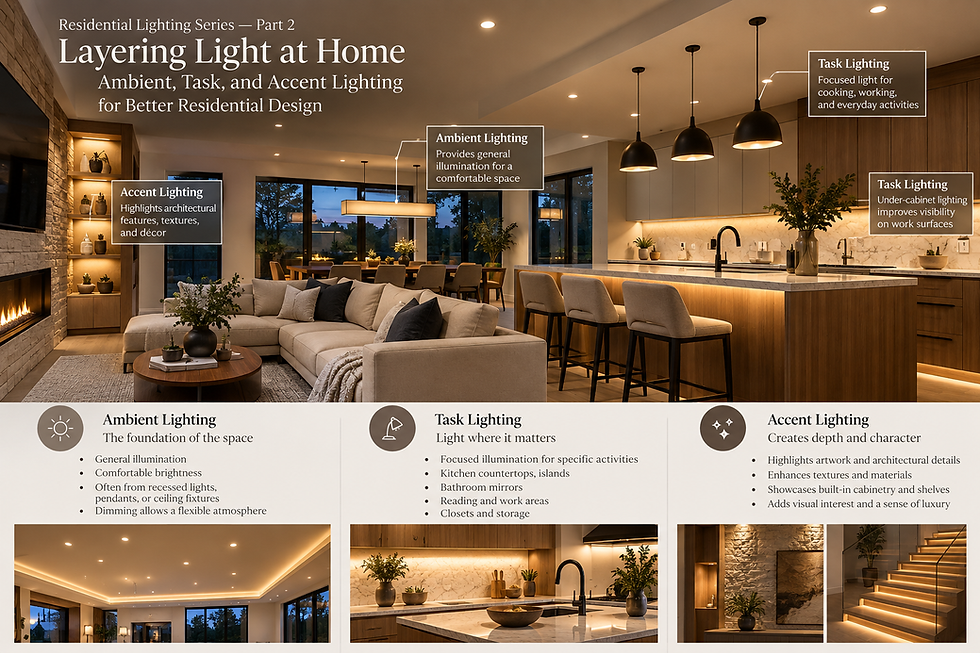
General ceiling lighting
Island pendants
Under-cabinet lighting
Cabinet display lighting
Dining lighting
Accent lighting
This allows the homeowner to create different combinations rather than simply choosing between “all on” and “all off.”
The same principle applies to living rooms, bedrooms, basements, and outdoor-facing areas.
However, more switches do not automatically mean better control.
An overly complicated wall filled with switches can become frustrating.
Good control design should provide flexibility while remaining intuitive.
That requires planning.
Smart Lighting Should Solve Problems, Not Create Them
Smart-home systems can add another layer of flexibility.
Lighting can be controlled through wall keypads, apps, sensors, voice assistants, schedules, and automated scenes.
But technology should serve the homeowner, not become an added complication.
Before specifying a smart lighting system, it is worth asking:
What does the homeowner actually want to automate?
Which functions should remain simple and manual?
Will guests understand the controls?
What happens if the internet is unavailable?
Can the system be maintained easily?
Will replacement components remain accessible?
Does the homeowner genuinely want app-based control?
The most sophisticated system is not necessarily the best system.
The best solution fits the lifestyle of the people using the home.
Lighting Scenes Can Simplify Everyday Life
One of the most useful applications of lighting controls is creating scenes.
Instead of adjusting multiple fixtures individually, one command can create the desired environment.
Examples might include:
MorningBrighter kitchen and bathroom lighting with selected circulation lights.
CookingStrong task lighting over counters and the island.
DinnerReduced general lighting with dining and accent lighting emphasized.
EntertainingBalanced lighting across several connected spaces.
RelaxingLower ambient lighting with lamps and accent features.
NightLow-level circulation lighting for hallways, stairs, or bathrooms.
These scenes illustrate an important principle:
Lighting is not just about rooms.
It is also about moments.
Consider Nighttime Lighting Separately
Nighttime lighting deserves special attention.
A homeowner walking to the bathroom at 2 a.m. usually does not need the same lighting level required at 8 a.m.
Very bright overhead lighting can feel harsh at night.
Low-level lighting can often provide enough visibility while preserving a calmer environment.
This can be achieved through:
Step lights
Toe-kick lighting
Low-level wall lights
Under-vanity lighting
Motion-activated circulation lighting
Carefully dimmed fixtures
These details can significantly improve how comfortable a home feels without necessarily adding visual complexity.
Daylight Should Influence Artificial Lighting
Artificial lighting should not operate independently from natural light.
Rooms change throughout the day.
A south-facing room may need very little artificial light in the afternoon.
A north-facing room may need more support.
A kitchen may receive excellent daylight during breakfast but require stronger artificial lighting in the evening.
This is where dimming, zoning, and automated controls become valuable.
The lighting plan can respond to changing daylight rather than remaining fixed.
The result is both more comfortable and potentially more efficient.
Energy Efficiency Is Part of Good Design
Don't treat energy efficiency as a separate engineering conversation.
It is part of responsible residential design.
Efficient LED lighting, appropriate fixture quantities, dimming, occupancy controls, and thoughtful zoning can all help reduce unnecessary energy use.
But efficiency does not mean sacrificing atmosphere.
In fact, a well-designed lighting plan often uses less light more effectively.
Instead of flooding an entire room with uniform brightness, you can direct light where it is actually needed.
This improves both the visual experience and the home's performance.
Controls Need to Be Planned Before the Walls Are Closed
Some lighting decisions are easy to change later.
Others are not.
Coordinate switch locations, wiring arrangements, fixture feeds, low-voltage components, control panels, drivers, sensors, and smart-home infrastructure before installing finishes.
This is where early collaboration becomes important.
The homeowner may understand how they want to use the room.
The designer understands the visual intent.
The builder and electrical team understand what needs to be installed to make that intent work.
When those conversations happen early, the result is usually cleaner and easier to execute.
When they happen late, even a small lighting change can require opening finished walls, modifying ceilings, or reworking millwork.
Test the Light Before Finalizing Everything
Whenever possible, evaluate lighting before committing to a large quantity of fixtures.
A specification sheet can provide useful technical information, but it cannot fully communicate how a fixture will feel in a particular home.
Material colours, ceiling heights, wall surfaces, beam angles, daylight, and furniture all influence the final result.
For important spaces, mock-ups or sample installations can be extremely valuable.
Seeing the actual light on the actual material often answers questions more effectively than reviewing numbers alone.
Think About the Entire Home, Not Individual Fixtures
A successful lighting plan is not a collection of good products.
It is a coordinated system.
Colour temperature should relate across spaces.
Brightness should reflect function.
Colour rendering should support the materials.
Controls should be intuitive.
Dimming should provide flexibility.
Smart technology should simplify everyday life.
Electrical planning should support the design.
And most importantly, the lighting should respond to the people who live in the home.
That is what transforms lighting from a technical requirement into part of the architecture and daily experience.
Creating the Right Feeling at Home
The most successful residential lighting rarely announces itself.
Instead, people notice that the kitchen is easy to work in.
The living room feels comfortable.
The artwork looks better.
The bathroom mirror provides clear visibility.
The bedroom feels calm.
The stairs are easy to navigate at night.
And the homeowner can change the atmosphere without thinking about the technical systems behind it.
That is the real value of understanding colour temperature, brightness, colour rendering, and controls.
Good lighting does more than make a room visible.
It helps make the home feel right.
Comments