
Residential Lighting Series — Part 2: Layering Light at Home — Ambient, Task, and Accent Lighting for Better Residential Design
A beautifully designed home shouldn't rely on a single light source.
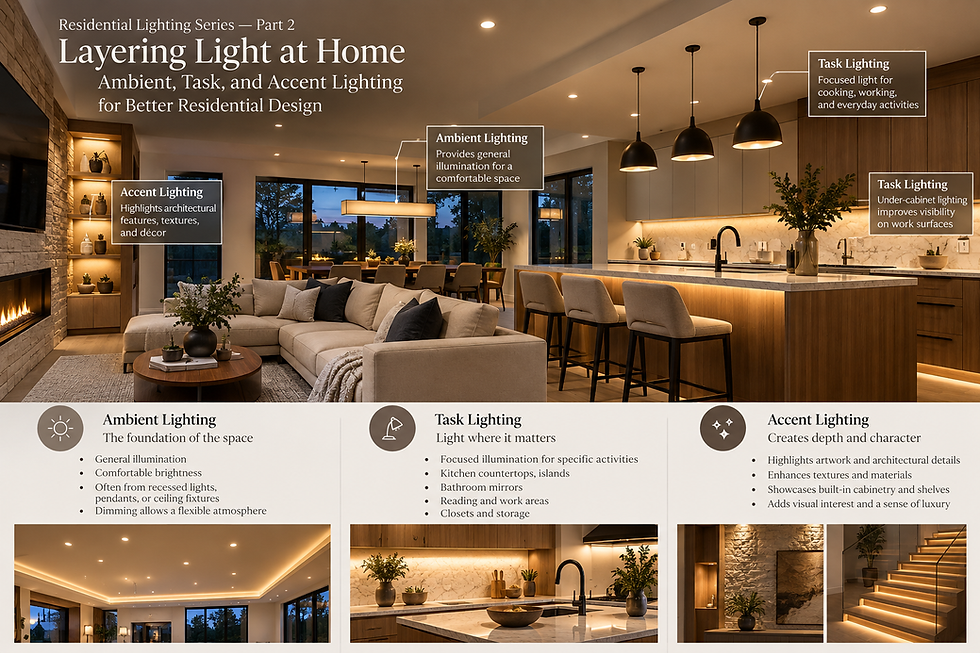
While natural light establishes a space's foundation during the day, artificial lighting takes over as daylight changes and lets the home adapt to different activities, moods, and times of day. The most successful residential lighting plans achieve this through layering—combining ambient, task, and accent lighting instead of asking one fixture or one group of ceiling lights to do everything.
This layered approach is about more than aesthetics. It influences how comfortable a room feels, how easily people move and work within it, how architectural details are perceived, and even how flexible the home becomes over time.
Why One Layer of Light Is Usually Not Enough
A common approach in residential construction is to provide enough ceiling fixtures to make a room bright. Technically, the space is illuminated—but brightness alone does not necessarily create a comfortable or well-designed environment.
A room filled only with recessed ceiling lights can often feel flat. The walls, cabinetry, furniture, textures, and architectural features may all be visible, but the room offers little variation in depth or atmosphere.
Layered lighting creates visual hierarchy.
Some areas can be brighter where activity takes place, while others remain softer. Architectural features can be highlighted without overpowering the room, and the homeowner can adjust the environment depending on whether they are cooking, working, entertaining, reading, or relaxing.
The goal isn't simply to add more fixtures. It is to give each light a purpose.
Layer One: Ambient Lighting — The Foundation
Ambient lighting provides the general illumination needed to move through and use a room comfortably.
It can come from recessed fixtures, ceiling-mounted lights, pendants, chandeliers, wall sconces, indirect lighting, or a combination of these sources.
The important question is not simply:
“Is the room bright enough?”
A better question is:
“Does the room have the right level and distribution of light for how it will actually be used?”
A family room, for example, may need enough general lighting for gatherings and cleaning, but homeowners may prefer a much softer environment when watching television or relaxing in the evening.
This is where dimming and separate lighting circuits become valuable. Instead of designing one fixed lighting condition, the room can respond to different situations.
For builders and designers, these decisions work best when coordinated early, before electrical rough-ins, ceiling layouts, HVAC locations, and millwork are finalized.
Layer Two: Task Lighting — Lighting Where It Matters
Task lighting provides focused illumination for specific activities.
In residential design, this can include:
Under-cabinet lighting over kitchen countertops
Pendant lighting over an island
Vanity lighting around a bathroom mirror
Reading lights beside a bed or chair
Lighting inside wardrobes and closets
Desk or workspace lighting
Laundry and utility-area lighting
Task lighting is especially important in spaces where people do detailed work.
Consider a kitchen. A ceiling may have excellent recessed lighting, but if the person preparing food stands between the fixture and the countertop, their own body can create a shadow directly over the work surface.
Under-cabinet lighting solves a functional problem that ceiling lighting alone may not address.
The same principle applies in bathrooms. A strong downlight directly above a mirror can create shadows across the face. Lighting positioned more thoughtfully around the mirror can provide better visibility and a more comfortable experience.
Good lighting design therefore looks not only at the room, but also at where people stand, sit, work, and move.
Layer Three: Accent Lighting — Creating Depth and Character
Accent lighting begins to shape the home's architectural experience.
Rather than simply illuminating an area for practical use, accent lighting draws attention to something important.
This might include:
Artwork
Textured walls
Fireplace features
Built-in cabinetry
Display shelving
Architectural niches
Stair details
Stone surfaces
Feature ceilings
Decorative objects
Accent lighting can add contrast to a space, helping certain elements stand out while others remain subtle.
It can also make materials feel richer.
A textured stone wall, for example, may appear relatively flat under uniform frontal lighting. When you illuminate it from a carefully chosen angle, shadows reveal the material's depth and character.
The same principle applies to wood grain, decorative plaster, brick, artwork, and custom millwork.
That is why lighting and interior design should ideally develop together, not independently.
Lighting Should Follow the Way People Live
Before choosing fixtures, one of the most valuable steps is simply understanding the homeowner.
How is the room used?
Who uses it?
At what time of day?
Does the family entertain frequently?
Do they prefer bright spaces or softer evening environments?
Does someone work from home?
Is artwork an important part of the interior?
Are children using the space?
Will the home's needs change over the coming years?
The answers can significantly influence the lighting strategy.
Two houses with similar layouts may therefore require very different lighting solutions.
Good residential design begins by listening first and selecting products second.
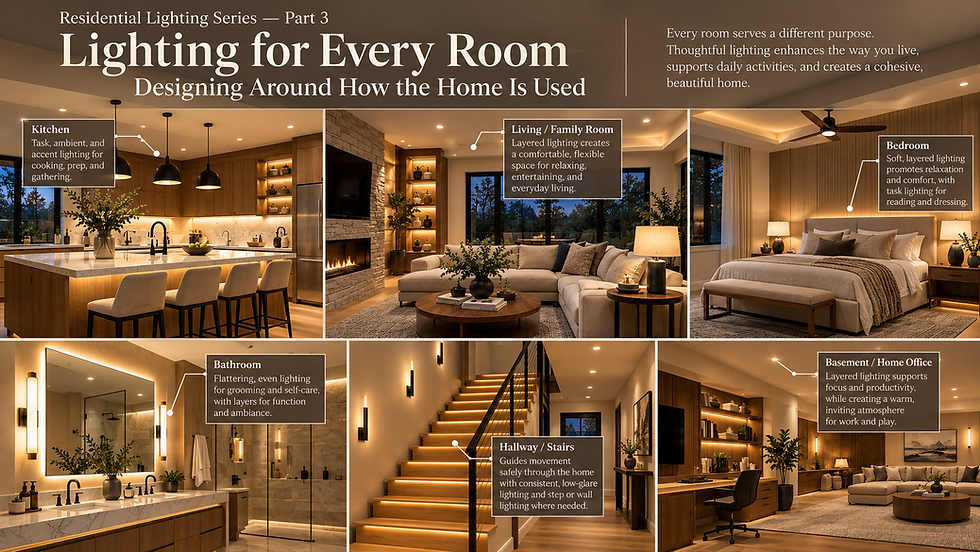
A Kitchen Is a Good Example of Layered Lighting
The kitchen demonstrates particularly well why different lighting layers are necessary.
General ceiling lighting may provide ambient illumination throughout the room.
Pendant fixtures over an island can help define the central gathering area while also providing focused light.
Under-cabinet lighting improves visibility across work surfaces.
Integrated cabinet lighting can highlight display areas.
A decorative fixture above the dining table can create another visual layer and help establish a more intimate atmosphere in the evening.
Each lighting element performs a different role.
Together, they create a kitchen that can transition from morning preparation to family meals, entertaining, and quiet evening use without relying on a single lighting condition.
Lighting and Construction Need to Be Coordinated
Some of the most important lighting decisions happen before you install the fixtures.
Ceilings often contain several competing building elements:
Recessed lights
HVAC diffusers
Speakers
Smoke detectors
Sprinklers
Structural elements
Access panels
Decorative ceiling features
If these systems are designed independently, the final ceiling can appear visually crowded or poorly coordinated.
The same issue can occur with cabinetry.
Integrated lighting may require electrical feeds, transformers, channels, or recesses that must be planned before millwork is fabricated and installed.
Making these decisions earlier can result in a cleaner design and reduce modifications during construction.
For this reason, lighting should be part of the broader architectural, interior, electrical, and mechanical coordination process—not treated as a decorative decision made near the end of the project.
More Light Does Not Always Mean Better Light
Another common misconception is that luxury means making every room brighter.
In reality, carefully controlled contrast often creates a more sophisticated environment than uniform brightness.
A well-designed room may intentionally contain brighter areas and softer areas.
The eye naturally moves between them.
This variation creates depth, atmosphere, and visual interest.
The ability to dim different layers independently also gives homeowners much more control over the space.
During the day, artificial lighting may play only a supporting role.
In the evening, ambient lighting can soften, task lighting can remain functional where needed, and accent lighting can become more prominent.
The same room can therefore have several completely different personalities.
The Best Lighting Is Often the Lighting You Do Not Notice
Successful lighting does not always need to call attention to the fixtures themselves.
Sometimes the strongest result comes when people notice the room, the materials, the artwork, or the architecture—not the light source.
Integrated linear lighting, concealed lighting, carefully positioned recessed fixtures, and subtle accent lighting can all contribute to this effect.
Decorative fixtures still have an important place, particularly where they become part of the interior composition, but they should work with the architecture rather than compete with it.
The goal is balance.
From Lighting Fixtures to Lighting Experience
Residential lighting design becomes much more effective when we stop thinking only in terms of fixtures and begin thinking about experiences.
Morning lighting.
Cooking lighting.
Working lighting.
Entertaining lighting.
Relaxation lighting.
Nighttime lighting.
Each may require a different combination of the same lighting layers.
By coordinating ambient, task, and accent lighting from the beginning, a home becomes more adaptable, comfortable, and visually engaging.
Ultimately, a successful lighting plan should support everyday life without demanding attention. It should make architecture feel stronger, materials feel richer, tasks feel easier, and the home feel comfortable throughout the day.
That is the real purpose of layering light.
Comments